Kumi and Circulor webinar #2 - Website image.001.png

20.03.2025

Webinars

Beyond the EU Batteries Regulation: Tackling global regulatory complexity with supply chain due diligence

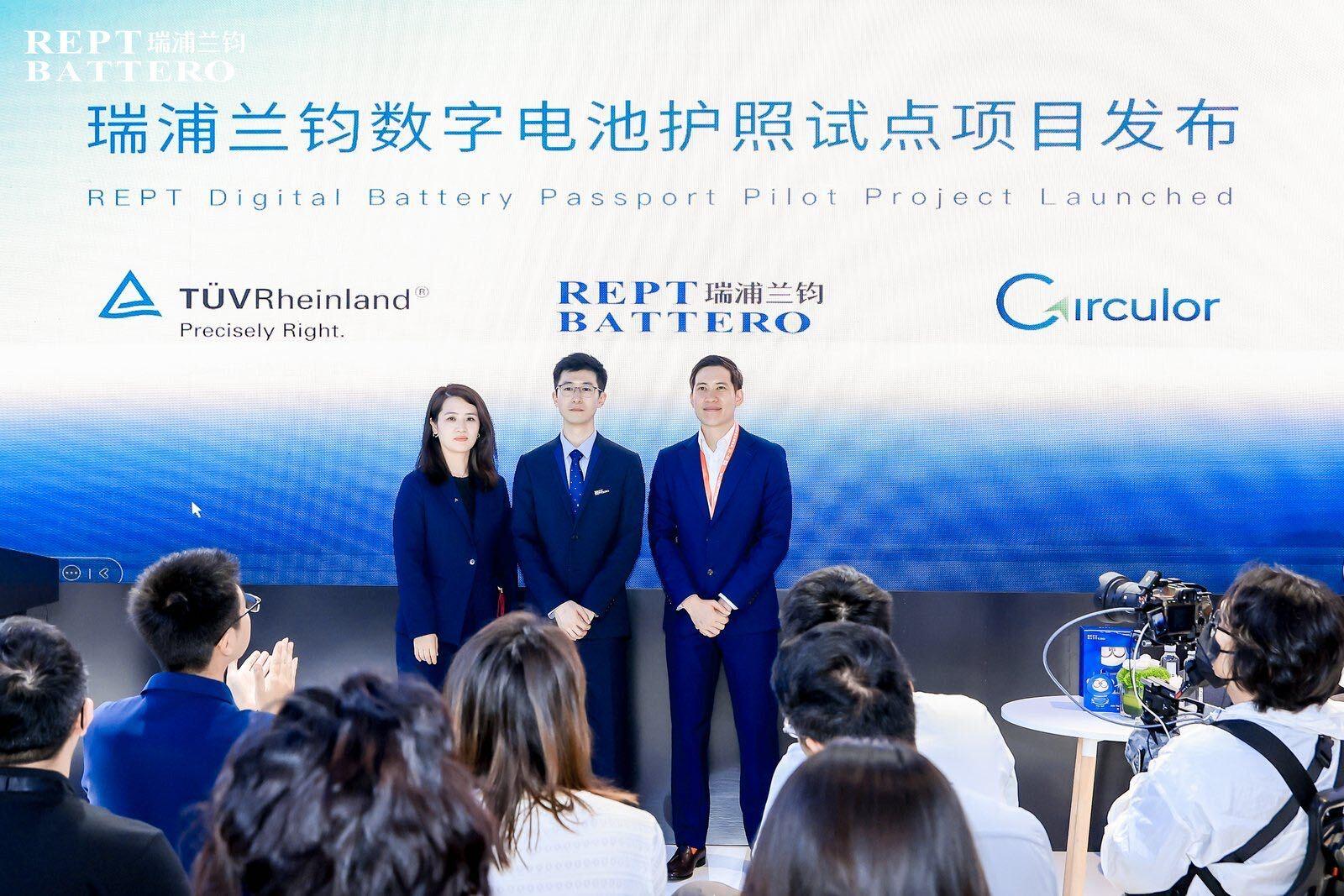
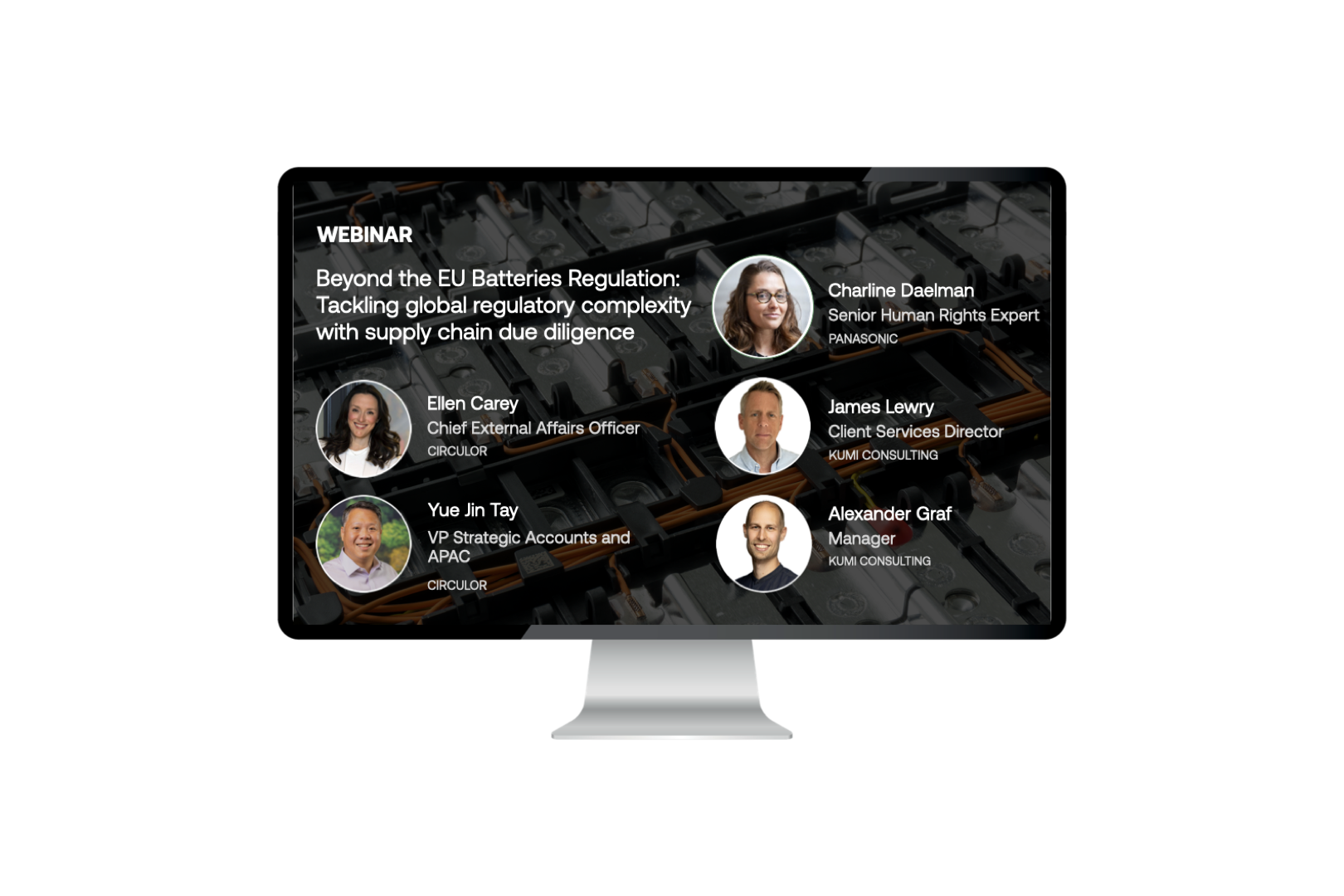
Kumi and Circulor hosted a joint webinar, alongside Senior Human Rights Expert, Charline Daelman of Panasonic, to unpack the global due diligence regulatory landscape - beyond the EU Batteries Regulation.

Kumi and Circulor Webinar - Beyond the EU Batteries Regulation: Tackling global regulatory complexity with supply chain due diligence - March 2025

Kumi and Circulor hosted a joint webinar, alongside Senior Human Rights Expert, Charline Daelman of Panasonic, to unpack the global due diligence regulatory landscape - beyond the EU Batteries Regulation. They discussed the potential impacts of the EU Omnibus and trade restrictions that should shape your global supply chain due diligence strategy.


Key takeaways for you:


- How to future-proof your compliance strategy

- The importance of collaboration across your supply chains

- How to structure your due diligence efforts in the face of ambiguity


They also discuss how traceability systems can be used to pinpoint due diligence actions that companies need to undertake in order to identify, assess and respond appropriately to social and environmental risks in battery supply chains.


If you have any questions on the insights shared in this webinar, or how Circulor can support your business, please set-up a meeting with our team here.


Webinar Transcript


00:00:05 - Ellen Carey

Hello and welcome. Thank you for joining Kumi and Circulor's second webinar on the topic of supply chain due diligence. We'll give a few minutes to allow everybody to join and then we'll get started.


Great, with that, I think we're ready to get started. Again, thank you for joining Kumi and Circulor's second webinar on the topic of supply chain due diligence.


My name is Ellen Carey. I'm the Chief External Affairs Officer at Circulor, the leading technology provider on supply chain transparency and material traceability. The global regulatory landscape in this space is becoming increasingly complex. Daily news on policies and their requirements, such as the EU Omnibus, leave businesses without much needed clarity.


Building on our previous webinar, today we'll expound on the EU Batteries Regulation, and will also broaden the context, the global regulatory landscape that shapes and informs your company's global supply chain due diligence strategy.


Joining me today, I'm pleased to share Charline Daelman, Senior Human Rights Expert at Panasonic. Alex Graf, Manager at Kumi Consulting and lead on Kumi's work with the European Commission on the EU Battery Regulation. James Lewry, Director of Client Services at Kumi Consulting, and Yue Jin Tay, Vice President for Customer Engagement and Strategy at Circulor.


Today, we'll cover how to approach uncertainty and ambiguity in today's global environment. We'll also talk about how to future-proof your compliance strategy, why collaboration across the value chain is critical, how to think beyond regulations, and how to learn from certain circumstances and efforts underway by those in your peer group.


For the first part of our time, I'd like to invite Yue Jin Tay and James Lewry to set the scene for us, globally, as pertaining to current due diligence policies and practices, and also pertaining to the EU battery regulation, what companies need to do, how are different players preparing given their maturity and their place in the value chain. This is what James and Yue Jin will share with us next.


From there, Charmaine and Alex will join the discussion, and we'll talk about the ambiguities in today's global regulatory landscape, how to address them, and how to tactically keep moving forward to reduce risk and continue preparedness.


Our goal is to make this an informative and valuable conversation for all of you, our audience. And in that spirit, we'll pause a couple times throughout to solicit your insights and experiences via some multiple-choice questions.


We welcome your questions via the Q&A chat function. We've reserved time at the end to address them, but if we get to all of them, please know that the Circulor and the Kumi teams will be coming back to you with answers after the webinar concludes.


Today's session is being recorded and a link to the recording will be sent to all registrants after we conclude. That is all for me, all the housekeeping, etc. I'm now pleased to turn it over to James and to Yue Jin.


00:03:54 James Lewry

Great, thanks so much Ellen and it's really good to be with everybody today.


So, after the past decade we've seen a dramatic shift from voluntary standards like the OECD guidelines and the UN guiding principles to legally binding due diligence requirements. Businesses are more aware than ever of environmental impacts, forced labour and human rights abuses in the supply chains of the things that we all buy and this has prompted robust regulatory responses worldwide.


So in the US, Canada, Australia, and the EU, new supply chain acts and trade restrictions are tackling modern slavery risks head on. For example, the German Supply Chain Due Diligence Act, and of course the proposed EU Corporate Sustainability Directive are setting new benchmarks for corporate accountability, even with the changes under the omnibus that Ellen mentioned earlier. At the same time, regulations like the EU Deforestation Regulation and Extended Producer Responsibility policies are really pushing sustainability further upstream in the supply chain.


And building on all of these developments, the EU Batteries Regulation now introduces some of the most demanding sustainability and due diligence obligations yet. It captures battery manufacturers and importers in the EU and is going to be pretty tough as it comes up.


00:05:22 Yue Jin Tay

The Battery Regulations establishes legally binding requirements across the entire battery life cycle, including mandatory due diligence for companies placing batteries on the EU market.


These companies must conduct due diligence on the social and environmental risks in their supply chains, aligned with the OECD framework. Specific thresholds for carbon footprint disclosure and minimum recycled content requirements for key battery materials such as cobalt, lead, lithium and nickel. Stringent traceability and chain of custody requirements for battery supply chains, setting it apart from broader due diligence laws. For example, it mandates digital battery passports for electric vehicle industrial and rechargeable batteries over two kilowatt per hour. In this respect, the regulation goes beyond voluntary standards by making traceability legally enforceable and integrating circular economy principles.


Another key difference is that unlike broader due diligence laws like the EU Corporate Sustainability Due Diligence Directive, or the CSDDDD, of known, and the EU Conflict Minerals Regulation, the battery's regulation is product-specific rather than company-wide. The regulation therefore seeks to reinforce the EU's commitment to sustainable supply chains under the Green Deal with the intention to level the playing field for companies operating within the region.


Now, that's a lot to digest in a short time. So James, what do companies need to do?


00:07:11 James Lewry

Well, pretty simple. You need to conduct due diligence in your supply chain on the four raw materials in scope of the regulation. And of course, these include lithium, nickel, coal, and graphite and their compounds, the battery active materials. Now there are 15 environmental, social and human rights risks which are identified within the regulation, and these have got to be considered within the due diligence. But those are not exhaustive.


The regulation encourages you to think more broadly than just those named risks so in practice, this means that due diligence and traceability need to go hand in hand. On the slide that you can see here, there are articles 49 to 52 of the Batteries Regulation, which specify eight requirements for management systems and processes that companies need adopt to be compliant.


Four of these requirements on the left-hand side here you can see they cover things that you need to have in place within a due diligence management system and this of course includes a policy, it includes making sure that you've got adequate oversight and responsibility for due diligence, it means also putting in place a system of controls and then encouraging transparency. It also includes an adequate grievance mechanism as well and this is something remains quite a key gap for most companies.


Now on the right-hand side the second set of requirements here all relate to processes, and this includes the assessment and response to risks in the battery supply chain, the third party verification of your due diligence process by a notified body and of course then the reporting requirements that you have.


So, in order to break this down let's have look at how each of these eight requirements lead up to August this year and to do so we'll break it into a roadmap as you can see on the screen. This is a road map of typical activity to follow to achieve compliance and again as Yue Jin was saying it looks like it can be a lot at first particularly given the August timeline but the reality is that most companies will have many of these items in progress already so some of the things that you can see there in terms of establishing the policies we talked about already but a key other item is about building awareness and capacity both within the business but also within the supply chain itself.


In terms of ongoing activities of course due diligence is one of those it's an ongoing process as is developing those risk response plans and monitoring those risk responses and then of course getting ready for the annual reporting that's required under the Batteries Regulation as well. But let's zoom in now on three of these activities and look at what's required in more detail. Yue Jin?


00:10:00 Yue Jine Tay

Thanks, James. First, map the supply chain and complete initial risk scoping. This is an early-stage activity that companies should prioritize so that they know what suppliers are in scope of due diligence requirements.


Secondly, establish a chain of custody controls underpinned by material traceability. This underpins your map supply chain with actual relevant flows of material.


Third, conduct progressively in-depth due diligence based on what is happening in your supply chain, and the material flows through your supply chain. What do we mean by material traceability?


The IEA, the International Energy Authority, and the OECD have published a comprehensive report on traceability in critical mineral supply chains very recently, back in February. It defines traceability as the ability to track four specific types of information. Firstly, the product's origin, that is, the location where the product was originally mined, manufactured, or produced. The product's geographical path, that is, the various locations where the product underwent some form of transformation or through which it transited. Thirdly, the product's chain of custody, that is to say the sequence of entities that help ownership or control over the product throughout the supply chain. And fourth, the product's physical evolution, that is the product's different stages of processing and transformation.


You can see on the next slide an illustration of what leading companies and their supply chains are doing with the help of technology. Each actor in the supply chain is connected and providing ongoing traceability data. To enable supply chain traceability, it is necessary to have sufficient clarity and certainty of the flow of materials through the end-to-end supply chain from source to manufacturer.


A key learning from six years of working with OEM customers is that participants in the supply chain is dynamic. It doesn't stand still. It is constantly changing. Chemistry's change, spot purchasing is common, especially when commodity prices fall, and midstream participants are driven by availability and price. Your due diligence is only as good as your knowledge of who is actually doing what in your supply chain.


Moreover, it's impossible for a range of other regulatory obligations to comply with other regulatory obligations without knowing exactly who is in your supply chain at all times for every import. As James mentioned earlier, due diligence and traceability need to go hand in hand.


00:13:10 James Lewry

Thanks, Yue Jin. So let's now look then at what businesses are doing as they prepare for compliance. And to do this, we thought it would be useful to show some examples of three different types of companies at different stages of maturity to see how they're preparing.


Now, the examples we've got are fictitious, but they are based on what we've seen in similar companies at these maturity levels. So starting on the left-hand side, Company A, which is Alpha Storage Solutions. This company is an OEM that manufactures and supplies battery products to European companies for energy storage and data centres.


Now, Alpha Storage is at the very early stages of its maturity and responsible sourcing, particularly with a limited supply chain and not having previously been in scope of due diligence regulations. Therefore, this company's pretty much at the start of its compliance journey for the regulation and is addressing gaps in its due diligence approach very quickly. At the same time, though, it has scoped much of what it's included in its supply chain in the four materials in scope of the regulation it's identified a limited number of suppliers and is now prioritizing the risk scoping of these. As a result, the company's found that its due diligence requirements are much more manageable than first thought, but it's still got quite a bit of work to do to develop its management system where there are key gaps in policy and grievance mechanisms.


On the right-hand side, you can see Company C, which is Cosmos online. Now Cosmos is at the other end of the maturity scale. The company sells the party goods in the European market, including electronic items containing batteries. And it also places its own branded products on the market as well. It's got a very mature sustainability program, but with thousands of third party suppliers and manufacturers due diligence under the batteries regulation is a big challenge in terms of scope and resources for the company. So to make due diligence more manageable, the companies developed a prioritized model for due diligence.


And this, of course, is in line with the OECD guidelines for multinational enterprises, which encourage companies with large chains to identify general areas where the risk of adverse impacts is most significant, and then to prioritize these. So the company's already mapped its supplier universe is now completing a risk scoping exercise to find out the country, the sector, the product and the raw material specific risks to help it further prioritise. It's also focusing on what we call so-called choke points within the supply chain to make sure it concentrates its efforts below its direct suppliers. Now choke points are where the number of suppliers is low, typically where batteries are produced or battery raw materials are refined and processed. And by taking this approach, Cosmos can channel its due diligence and traceability efforts, especially where the upstream raw material chain is complex.


00:16:19 Yue Jin Tay

In the middle of the maturity scale is BetaCars. This is an automotive OEM, which has identified its upstream critical minerals supply chain in collaboration with its tier 1 suppliers. Based on this initial supply chain map, it actively assesses due diligence risk of each of these suppliers using OECD-based assessments.


On the back of these assessments, the OEM will take risk-based decisions to optimize the participants that are in their supply chain. They then onboard in conjunction, onboard each supply chain actor to implement a solution for ongoing provision of material traceability data to ensure that the raw materials did originate and flow through the expected sources across the supply chain. The traceability solution tracks and verifies the flows of material and flecks alerts where the expected traceability data or material flows does not comply with what is expected.


This enables BetaCast to establish verifiable proof assurance of what is happening in the critical minerals supply chain and to identify with follow-up due diligence actions what needs to take place, creating a continuous feedback and improvement loop. This is a good starting point for them to then expand to cover other critical minerals across the entire supply chain. Thank you very much and I'll hand the time back to Ellen.


00:18:04 Ellen Carey

Thank you, Yue Jin and thank you, James. Really appreciate that thorough scene setting on what you're seeing with customers and also what you're seeing in terms of the current environment and requirements in this new global precedent setting regulation.


With that, I'd like to bring in Charline and Alex and Yue Jin to have a broader, more candid discussion. Again, Charline is the senior human rights expert at Panasonic, and Alex is the manager and lead of Kumi's work with the European Commission as well as the battery regulation.


So maybe, Alex, we start with you, because, you know, there's a lot of news today and all the time it seems like, especially I think maybe we should root ourselves in the reality of the here and now. So let's talk about the omnibus and the EU omnibus proposal. What does the uncertainty that the omnibus presents? What does it mean in practice? And how are you advising customers today? Do we anticipate also that the European batteries regulation will be affected by this omnibus as it advances and proceeds?


00:19:23 Alex Graf

Thanks, Ellen. And yeah, thanks also for starting with the elephant in the room kind of within the European perspective, at least. Yeah, so maybe let's start a bit with the advice, at least the general advice from how we see that Kumi and how we advise our clients in this regard. And I think first and foremost, our main message is stay calm.


Stay calm despite all the speculation, despite all the current developments, about whatever the final CS3D may look like, and of course, also watch out closely for the guidelines once they're coming out.


But perhaps the most important message in this regard, and I think I will repeat myself today, this is one of the main messages I think I want to get across, and I also tried to get across last time in our last webinar already is, really understand what risk-based due diligence is about, how to apply risk prioritization, what are the main components of this in terms of from risk scoping, to in-depth assessments, to addressing risks, etc. Because this is the core substance of due diligence law, maybe the CS3D, maybe the batteries regulation. And it is also at the end of the day, what will make due diligence manageable in vast supply chains as they will be in scope with the CSDD.


Now, in terms of the uncertainties that you mentioned, well, the current CSDD proposal, so the new omnibus proposal, the changes therein are mainly in terms of scope, liability, timelines, et cetera, at least by and large. That means, however, that at the same time, the core process, as I just mentioned it, the actual due diligence practice and the actual systems and processes as they are needed, well, did not change in this regard. They are the same.


So again, the same messages, despite all this uncertainty, focus on the core processes. They did not change in this regard. Understand what risk-based due diligence is about, because this is what you will need to do at the end of the day, in any case. And this also relates then, I would say, to the question of, or includes at least the question of, well, what are the administrative burdens? Because a lot of the omnibus ambition, and I think both Kumi and Circulor, I would argue, are fully in support of that, are about simplification, about harmonization and in order to achieve this, understanding where the real burdens often are is also crucial. And where they are, again, is in kind of certain practices, as we know them from due diligence for example, how do we collect information? What information do we collect? When do we collect it? How do we treat audits? When do we use them and how do we use them? How do we use contractual obligations in order to push for and enforce due diligence in the supply chain, et cetera?


So understanding again how to use these tools within risk-based due diligence together with supply chain transparency, I think, is a key component here. And this what companies should focus on despite all the uncertainties, because this remains unchanged. And just as a last add-on, because you also asked the question in terms of what does it mean for the batteries regulation. Well, the current form, as we know it for the omnibus, new batteries regulation is not included. This is the current status. Of course, we don't know how future rounds or how future developments regarding the omnibus will look like, but the information as we have it, is not included.

In terms of the of the guidelines and the ongoing process of the batteries regulation, well probably many of you know it anyway, the guidelines have been planned for February 2025, so last month they have not been published. Why? Because there is at the moment a certain kind of waiting position on the side of the Commission but also on our side in terms of well looking and seeing what is the outcome of the omnibus in this regard. But as of now, no direct implications that we would know of. Yeah, so I think I would leave it with that, but the main message is understand the core processes, what is needed in terms of diligence, in terms of transparency, and focus on them because they will stay and they stay as we know it.


00:24:00 Ellen Carey

Thank you, Alex. That's great. I really appreciate it. And I think that segues really nicely to turn to Charline and what she's doing within Panasonic.


So Charline, as you and Panasonic prepare for the EU batteries regulation, what have been the main challenges you faced and how have you been successful?


00:24:21 Charline Daelman

Yeah, thank you so much, Ellen, for that question. It's probably a question that is also very relevant for many of the participants here today. So like any company right now, whenever there's any upcoming regulation, the first thing that we do once adopted, and of course in the preparation, is that we have to assess the following elements, right


First of all, what is it that we need to do as a company and who needs to do this within the company? Secondly, why do we need to do this? And thirdly, how do we need to do this, right?


So on the first challenge on trying to identify the what, this is really for us then about understanding EU Battery Regulation and also understand where do we need to start, how can we prioritise, right, because it's a very multifaceted regulation as was already referenced too in the beginning as well. So this means for the what we need to get down to two basic levels of understanding.


First of all, we really need to understand the text of the EU Battery Regulation and try to translate it into practical required actions, right, and then again try to pinpoint it to which actors within the company will have to do what. Secondly, and this is a very important one, of course, is contextualization. So one thing is trying to understand the letter of the text. The second one is contextualization. So this is really us trying to understand how does the text concretely apply to us as a company and in which particular areas of our business are impacted by the text and by the requirements.


For example, for us, practically speaking, this meant that we really needed to understand which areas of our business were directly impacted because we have certain actors within our business that are considered as economic operators. But then of course also this regulation as any regulation might also bring an indirect sphere of influence. So meaning that we also have actors within our company that can be seen as suppliers to economic actors, right? And so how will that play out?

And from a we understood that, of course, you always read the letter of the text, but it's very important also when you're contextualizing and trying to translate it into practical actions, is to understand the spirit of the text, right? Rather than just the mere letter of the text. So in that context, what we then understood was that actually for the EU Battery Regulation and if you read it, it goes back to international frameworks, which are already there, right?


So a lot of the requirements we see in EU battery regulation go back to basic principles, which have already been provided to us in the UN Guiding Principles on Business and Human Rights, but also more practically, reading the text, you see they go really back to the OECD relevant guidance’s on responsible business conduct, but also due diligence for responsible supply chain minerals. So this means that this approach still today is helping us also addressing the ambiguity that is now created by omnibus and of course also the delays in the much anticipated commission's guidance.


For us while we were doing this contextualization and understanding process and we're still doing it today of course and it is and remains for us very crucial to consult with our internal content, but also external experts and advisors such as Kumi and Circulor, but as well as practitioner, we also have the practitioner's viewpoints, so meaning the relevant actors within our company from the different departments that will be tasked with these implementation activities, right?


So as a result on the what, and at least the exercise on trying to understand it better, you were able to strike a balance between different potential interpretations, and this resulted in what we would see as the best actionable, feasible and effective manner forward for Panasonic. But of course, having said that, we still very much looking forward to any specific and more guidance from the Commission if it would come out.


Then the second area was of course the why. I think this will again relate for many of us in the audience. You of course determine what needs to do, but why do we need to do it, right? And, of course, the first important actor or the first important reason why to do it for most of us, I guess, as an initial starting point is, of course, it's an exercise of regulatory compliance. Regulatory compliance for ourselves falling directly under it, but, of course, also it being translated in any requests we get them from customers, right?


So again, for us, it's about meeting the expectations of key stakeholders such as customers, but of course, also other important stakeholders. This is, of course, an important driver, but this should not be the only driver, right? Because if this is the only thing that drives you in this story, then if it falls off or if you're confronted with what we are seeing today, for example, also with omnibus, then this might delay or maybe even stop the process within your company, right? So again, from an early age, early stage, of course, regulatory compliance was important, but it was for us more a part of it, it's not the end goal.


And so for us, other drivers that we've always considered is that we need to really acknowledge due diligence and also as it is required by the EU Battery Regulation as a very efficient risk assessment tool that identifies human rights, environmental risks but also recognizes those risks as actual risks to your business, right? So it's very beneficial to keep on going forward on this exercise, regardless of whether certain regulations are now paused or under revision.


And then lastly, and this is of course a benefit we had within Panasonic, but actually us now implementing and also strengthening our due diligence efforts, it contributes to a materialization of the basic management objective, which was put forward by founder of Panasonic, Kōnosuke Matsushita, who said that basically companies should see themselves, well, should recognize the responsibility as industrialists, and so therefore we need to devote ourselves to the progress and the development of society, and of course the well-being of people throughout our business activities. This is something that we've also consistently have been referencing too, and it's ingrained in the basic mission of us as a company, right? So this really helped us also internally to keep on engaging with the stakeholders internally and keep all the noses in the same direction.


Then lastly, on the how, of course, we all recognize that the EU Battery Regulation entails many, many different requirements. Of course, here we're focusing primarily on due diligence, but it has much more. So, this means that its practical implementation is very demanding and is actually very multifaceted. So this means requires actually a lot of decision taking and actions that need to be taken at different departments and by different levels.


For us, this means both at a holding level, but also at the operating company level. So for this, we realized again early on that we need a vehicle within the company where such discussions can be streamlined and also that can support necessary decision-taking processes. So for us, this resulted in the setup of EU battery task force that is actually consisting of different functions. And this EU battery task force functions as a central point that is leading any implementation of EU battery due diligence activities currently within the Panasonic Group.


Important also is that this battery task force is actually connected to a wider due diligence project that we have ongoing. And again, it fosters this whole understanding that again, whatever we're doing in EU Battery Regulation and the specific due diligence requirements here feed into a more holistic due diligence approach as a company. Of course, this vehicle and this battery task force, besides it being a forum for alignment and decision taken, it also contributes to implementation ownership because we are able to assign specific tasks and responsibilities to different people and departments. But it also helps us to define which are the areas where we also still have to build capacity, right? So it's one thing that everybody understands what needs to be done, but concretely speaking, often the people within the companies having to do it, we also have to invest in building their capacity to be able to do it, right? So yeah, for that I will leave it, but thanks so much.


00:33:17 Ellen Carey

Really insightful, Charline. Thank you so much. I especially appreciate you talking about the OECD and UN guidance and how that's very informative of all of this global policy regulation. And then also kind of rooting the culture of Panasonic is rooted in proper supply chain due diligence and then how that also informs how you organize internally within teams, capacity, and working together. Really helpful.


I think with that, we're going to solicit some input from the audience members and see what their thoughts are. So I'd like to prompt a question to the audience, which is based on the EUBR due diligence obligations, what gaps does your company face and where would support be most valuable from an external provider? I'll give a couple minutes for folks to weigh in with their thoughts here.


Okay, great. On to the next question and Yue Jin, I don't want to leave you out, so we have to bring you into this fold. I want to talk specifically about Articles 49.1d and 49.2, which call for a system of controls and transparency regarding supply chains, including chain of custody and traceability systems. From your interpretation, how can material traceability be a tool for this? And then broadening out from compliance, kind of as Charline mentioned about like, this isn't just a checkbox compliance exercise. How can this also serve greater business effectiveness and efficiency?


00:35:03 Yue Jin Tay

Well, thanks, Ellen. The due diligence requirements of the battery regulations requires companies to provide verifiable and auditable traceability data and the supporting documentation to prove the provenance, material flows, and the quantities as such, as well as the inherited upstream risks for both primary and secondary materials. This is increasingly being seen as the standard practice for downstream companies as they realize that what they have been promised is not in fact what's happening in reality.


So it's not just about meeting the regulations, but actually about addressing your business needs as well. The recent IEA and OECD report that I referred to also makes this point very clear. From my experience, our downstream customers need this continuous connection and visibility to what is happening upstream from them. So for lithium, cobalt, nickel, and graphite, for example, we're connecting all upstream supply chain participants and physically tracing the flow of materials through their internal system processes and controls.


While supply chain mapping is the first initial exercise, as I mentioned earlier, companies are realizing that doing this once a year or once every couple of years is just not good enough anymore. So we build on the supply chain mapping exercise by creating from there rail material traceability. And as Charline mentioned earlier, working this way should not just be about meeting the regulations. It should be about creating business value and business resilience through transparency and greater accuracy and efficiency. Doesn't always mean more headcount and costs in order to accomplish this.


00:37:07 Ellen Carey

Thanks, Yue Jin. And I like that you, you know, tied traceability to supply chain mapping, which also in that IEA OECD guidance, they're very clear in their definitions of what is what and that's very helpful. I think you also mentioned it becoming standard practice.


So I'd like to ask Alex to take us more globally and look at, you know, how are other markets, we have to focus a lot about the EU BR and its requirements by August of 2025, but give us a sense, Alex, because you're looking all around the world as to how is due diligence now being practiced, especially for other market requirements?


00:37:54 Alex Graf

Yeah. So, I mean, looking globally, you can definitely see there's a lot going on in terms of legislation, in terms of product passport standardization, etc, when it comes to due diligence, traceability, and when you look at these things, you may sometimes get the impression that there's quite some fragmentation happening or you are asking yourself, where is the coordination between these efforts globally?


But I think what you can clearly see is there is a trajectory towards due diligence, towards more due diligence and towards more supply chain transparency and traceability. You can definitely see that not only in Europe, but also when you look well to both sides left and right side of Europe, so to speak.


Of course, there is also a certain uncertainty connected to these developments and how this will go in the future. Also, for example, due to the current political shake and wake up, so to say in terms of across the globe to refocus more on resilience, economic resilience, competitiveness, etc, what we can see in this regard. But still there is kind of a common understanding that this has to go hand in hand with, let's say, a minimum amount of sustainability and responsible business conduct also throughout supply chain.


Now, obviously, what these so-called minimum standards should look like are hotly debated, also in terms of who sets the standards, who dictates what these minimum or what this minimum amount of sustainability, et cetera, should look like. And this, of course, again, then creates a lot of uncertainty in this regard.


However, I think it is also clear what you can also see when you look at these developments that again, very much those international frameworks that I hinted at and that also Charline reconfirmed and mentioned in terms of the UNGPs, the OECD guidelines, et cetera, they do underpin these processes in one way or another. So again, I think this is a very important common basis, however, the details then may look like.


So, from our perspective, again, the advice that we would give clients is rather similar to what we give them in terms of the omnibus. Stay calm, watch the developments very closely, and just really try to get a clear understanding of, well, again, very nicely put by you, Charline, what the spirit is of risk-based due diligence of these international frameworks, and get this right because this is also then how we support companies in preparing for different legislation, simply by getting this core substance of due diligence right first, and then you can build on that in terms of due diligence, in terms of transparency, whatever is needed, and react to any sort of specific developments as they occur.


00:41:02 Ellen Carey

Thanks, Alex, really appreciate that. I'd like to ask a poll or solicit some input from the audience one more time. So how far along are you in your preparations for due diligence and responsible sourcing regulations? And how do they impact your business? Where are you in the journey? As James and Yue Jin noted, there's in the beginning, there's the forming, there's the performing. Where do you stand in your journey?


Give it 30 more seconds and then we'll continue on.


Great. Thank you for giving us your input. Charline, we've talked about engaging supply chain participants. So I'd like to turn to you for how you're doing that and how Panasonic is doing that. So what lessons has Panasonic learned through its supplier engagement and what advice would you give other companies in their journey, wherever they're starting?


00:42:11 Charline Daelman

Yeah, yeah. Again, if we look at the EU battery regulation and you compare it with your diligence requirements as such, a big difference is of course that EU Battery Regulation really requires us to map our supply chains even deeper. So we really have to identify where raw materials are being sourced from, how where and how they're being processed. So the difficulty there is of course to be able to go that deep while still respecting the autonomy of your suppliers is quite challenging, right?


So this means that what we've seen is that we really need to focus on trust building as well as trying to find creative approaches allowing the suppliers to share such relevant information that we need to conduct those risk analysis but of course also still respecting and not asking them to give up on their supply chain data ownership. So that is a bit of a critical point. Our understanding up until this point is of course that for such trust building to be there, you really have to engage in dialogue with your suppliers.


And while you're doing this, while you're engaging with your suppliers, you have to do it or you have to foster an environment that emphasizes, of course, transparency, but at the same time also keeps on emphasizing continuous improvement on both sides, right? So it's not about hitting the ball perfectly right from the beginning. So this is, I think, an important point that we always try to apply when engaging with our suppliers. I think everybody needs to understand that this process really requires a lot of time and also continuous reiteration, right? Because as you also engage on those conversations with your suppliers, hopefully, there will be a lot more trust building and more information will be shared, right? So this also then allows you to continuously iterate your original risk assessment.


For us concretely as Panasonic then, and in relation to the EU Battery Regulation, this meant actually that we are engaging with our relevant suppliers by first of all, providing them with sufficient contextualization and education on the EU Battery Regulation so they understand where our requests come from. And we do this via briefing documents and of course where necessary we might need to reinstate our contractual frameworks where needed.


And furthermore and then this is also based on inputs that we ask from our suppliers via a very tailored survey. By getting those inputs from our suppliers we also start to understand better where our suppliers are on some kind of a maturity matrix, right. And then this allows us to, again, prioritize certain suppliers for more continued engagement and talking with them. And, of course, it also allows us to inform where do we need to take very specific follow-up actions and also maybe invest in capacity-building activities of suppliers. So that's how we try to tackle this very challenging.


00:45:32 Ellen Carey

It sounds very continuous, like you said, communication, transparency, dialogue, and education as well. So, Yue Jin, maybe over to you. How do you see collaboration among supply chain participants and their economic operator?


00:45:51 Yue Jin Tay

Yeah, I like Charline's point about continuous improvement, the whole Kaizen spirit, and in that vein as well, collaboration is important because in this day and age, rarely would a downstream customer own or control the end-to-end supply chain. So you have to work with other folks in the supply chain without a doubt.


Our experience and our work with customers in the supply chain, in the way that Charline describes focuses on collecting only the necessary data to enable reliable material traceability and to support the due diligence that's required. And as a neutral third-party platform, maybe this is where the creative means comes in, the technology can ensure that only the pre-agreed data from what was collected is visible and visible only to the relevant downstream actors in the supply chain. So fully respecting the rules of engagement that have been agreed. And this creatively enables assurance, which can be verified, but without full data disclosure throughout the supply chain. So it's not a one-size-fits-all approach.


For example, we help customers to implement the battery passports. That is a very real example. And using our solution, customers can distinguish between the information that they choose to disclose publicly in these digital product passports, with the underlying primary data that has been collected from the supply chain, which is separately used for verification and audit purposes. So distinction between the data that's been collected and what is then visible and what is then shared as well.


Similarly to Charline's point, traceability isn't and cannot be the end goal. It's a means of achieving resilience and doing better business. Our discussion today has been very much focused on due diligence. There will be other business opportunities and objectives that only more connected end-to-end supply chains can support.


00:48:09 Yue Jin Tay

Thanks, Yue Jin, especially to the topic or the theme that Charline mentioned about dialogue. I appreciate you coming in with the specifics on that dialogue and that not everything is shared, certain information is shared and certain information is not.


So let's bring James back into the conversation here. And I know that we've gotten some questions from folks who are participating online. So let's turn to those and make sure we get as many of those answered in the next 10 minutes.


So, let's see, first one, James, welcome back. First question, when will the Commission publish the EUBR due diligence guidance and what impact does the delay have on the upcoming deadline? James, I'm going to hit you first.


00:49:02 James Lewry

Great. Well, thanks for bringing me back in. And honestly, we don't know to this question. So, the commission hasn't announced when the final due diligence guidance will be published. But as has been said already by the panellists, we do know what it will be based on. And because the guidelines themselves align with frameworks like the OECD due diligence guidance and the UN guiding principles that Charline mentioned, but also, of course, the conflict minerals regulations, at this point, we really do know what needs to be done.


So, I would say that while the delay creates some uncertainty ahead of August, which is of course the compliance deadline for the batteries regulation, there really is no need to wait. So, going back to what we were saying earlier, I think start mapping supply chain risks, engage suppliers now and prepare to disclose due diligence efforts and use those existing standards as a reference point.


00:50:01 Charline Daelman

Maybe, Ellen, if I may compliment James, I mean, still for us as a company, then, of course, the guidance would still be very much welcome there. The reason is that I think we're all currently today being confronted with what I would call the interpretation guessing game, both internally and externally for companies. What we see is that actually that guessing game is requesting a lot of our internal resources, which could otherwise actually be much better targeted to actual implementation. So that's the first thing, and that's why we would welcome.


Secondly, and I think this is something that James and Yue Jin were already referring to in the introductions as well, and there's something like power dynamics in the supply chains as well, right? So meaning, meaning, as long as there's no consistent interpretation being put forward by the commission, most of the interpretations that will take shape mostly in supply chains are the ones that are adopted by the top tier companies right and of course those are not always aligned which again makes it very challenging for mid-tier companies to respond to those requests right of the of the ones in the top tier so yeah for those reasons and probably for a lot more as well but yeah we would still very very much welcome the guidance provided by the commission.


00:51:20 Ellen Carey

I think what you both said here makes a lot of sense we're not really missing any information or details. However, that lack of clarity is still brewing some confusion that doesn't help business. Yeah. Okay. The next question, let me pull one up here. Do I need data and information from all the suppliers in my supply chain? Alex, would you like to chime in on that one, please?


00: 51:51 Alex Graf

Yeah. Thanks, Ellen. Let me try. So well, the short answer is probably yes and no.

And you can look at it from, well, if you want from two sides, one is, of course, the legislative side, if you want, so what does the regulation, for example, the batteries regulation itself say in this regard, what information is needed and do we need information about all suppliers?


And then maybe the other perspective would be more from a practitioner's side, so what information do we really need in order to conduct meaningful due diligence, if you want? So, from the regulatory side, well, obviously there is, and we mentioned it already, there is Article 49.1d, if I'm correct, as well as Article 49.2, the System of Controls and Transparency, which outlines basically the data points that you will need to collect. And if you look at it to a certain extent, yes, you will require to collect information about more or less the entire supply chain and the guidelines will hopefully also help to clarify what this means more specifically in terms of the different data points.


From a practitioner's point of view, still well of course in an ideal world we would have all the information about the supply chain from supplier identities to where they are to what they do etc because the more information we have, the more well, specifically, and the more targeted we can then actually act and identify and address risks. But we all know that the reality looks very different.


Many companies don't even know much beyond their direct suppliers. But at the same time, you still can conduct meaningful due diligence. And this brings me back again, one more time, a risk based approach. And this is also what we then propose to certain extent in the guidelines when it comes to supply chain transparency, you will need to collect a minimum amount of reliable information. Not necessarily full supplier identities and everything from the start. But based on this minimum amount of information, you can then go back, compare this, for example, with your risk information, with risk scoping information that you have. What are your risk priorities in terms of countries, in terms of types of suppliers, etc? Basically, compare and triangulate this information to zoom in and say, okay, and these are the areas. This is the type of supplier. This is the country where I need more information now. And then basically in a risk-based approach, a dig deeper without needing to have all the information from the start. So this would be a risk-based response to that. Let's see. And let's stay tuned for the final version of the guidelines so you will see more later.


00:54:29 Ellen Carey

But that helps. Thank you very much, Alex, for providing that insight. Charline, the next one seems up your alley. So how should businesses handle suppliers who do not provide the necessary data? And what documents are required for evidence? And how do we encourage supplier compliance, especially maybe for traceability?


00:54:53 Charline Daelman

Well, let me focus a little bit and build further on what I already mentioned before, right on how we engage currently with our suppliers. So like I said, it's always about striking the thin line, the right balance between gathering the relevant data and still respecting the autonomy of our suppliers.


So what we see is that if a supplier would be reluctant, then again, it's going back to the dialogue, right? So we really need to then speak to the supplier, understand why they are reluctant and then see again on the basis of that input, whether we can find any practical or creative solutions so that the data can still be shared, but in a manner that they feel more comfortable, right? The way that we encourage compliance, again, I think it's important always to contextualize. If you approach your suppliers and you just give a list and you say, basically, this is what I need, but you don't explain to them why you need that information, I think it will be very difficult.


So big part of our contextualization is also making them understand that we will not be alone in our request to them, that probably they will have other customers coming up with similar requests and so therefore tailoring to our request is also facilitating any future requests right they might get from other customers and secondly um yeah again that they understand that for us this is part of a continuous improvement journey so it's not about them sharing information on and on that basis we will, I don't know decide to stop the relationship with them on the contrary it's about them sharing the information so we can also understand better how we can support them in continuously building their capacity, right? So, yeah, that's in short from our side.


00:56:38 Ellen Carey

Super, okay, Yue Jin, 30 seconds on that one.


00:56:41 Yue Jin Tay

Sure, I mean, onboarding supply chains for traceability is challenging. There's no doubt about that because transparency can be quite exposing. And also, changing a well-established way of working can also be challenging as well, both operationally and even culturally.


But what's important is that the voice of the customer throughout the supply chain is crucial in order to enable collaboration and creative solutions to take place. And I think the other thing as well is it's always important and helpful to get to the why, to understand what is actually behind the no. Is this a reason? Is this an excuse? Are there certain fears and concerns that are actually unfounded? Or are there actually real commercial, technical, and operational issues? So understanding the real concern is the starting point to work out the way forward, as Charline said.


And the thing is that this should not be a new thing. Customers have a history of working with their suppliers in terms of educating, training, that dialogue, working together to adopt and implement new standards, new ways of working you know, in support of their joint strategic objectives, this could be technical quality. This time around, we are talking about human rights, environmental impact, sustainability, due diligence. This is no different to what normally happens.


00:58:11 Ellen Carey

Okay, super. Alex, I got a question here. I don't want to skip it. 20 seconds. What do we know about the role of notified bodies and audits in ensuring compliance. I know that's a key part from this guidance from the European Commission that we're lacking. How should we handle this without the clarity? So 20 seconds, starting the clock.


00:58:31 Alex Graf

Okay, so well, the official answer is, at least to my knowledge, happy to be challenged. There are no notified bodies under the batteries regulation in general. At least I know there are none for the diligence. So in that sense, there is uncertainty and it will remain.


Two pieces of advice here. I said it time and again, no day with the guidelines, no day international frameworks, at least then there won't be any big surprises. And number two, be aware that the uncertainties on both sides. So also for legislators, also for upcoming notified bodies to diligence is a very new topic. It will be challenging for them as well. So there will be, this is my personal view, there will be some sort of transition period.


The last and then I'm done, maybe I have five seconds left. Keep, really for companies, keep a clear documentation about your choices. Why are you doing it? What are you doing? What gaps do you know? And also how will you address them in the future? Just be transparent about the implementation, because then at least you follow the principle of continuous improvement, which is a very foundational principle of risk-based due diligence. So just do Yeah, yeah, that's my advice.


00:59:43 Ellen Carey

Thanks, Alex. We are right at time and I don't want us to go over and I know folks have other meetings to get to so thank you all for the panellists for joining.


Thank you to our audience. If we didn't get to your question, you can expect to hear from us in other communication forums getting to your questions so that there is more clarity in this space. So thank you again and we wish you a good day.